The conductor calculators, on the phone in your pocket. For the work that does not need a whole survey job: a sag to string to, a span to check, a pole to lift a line off.
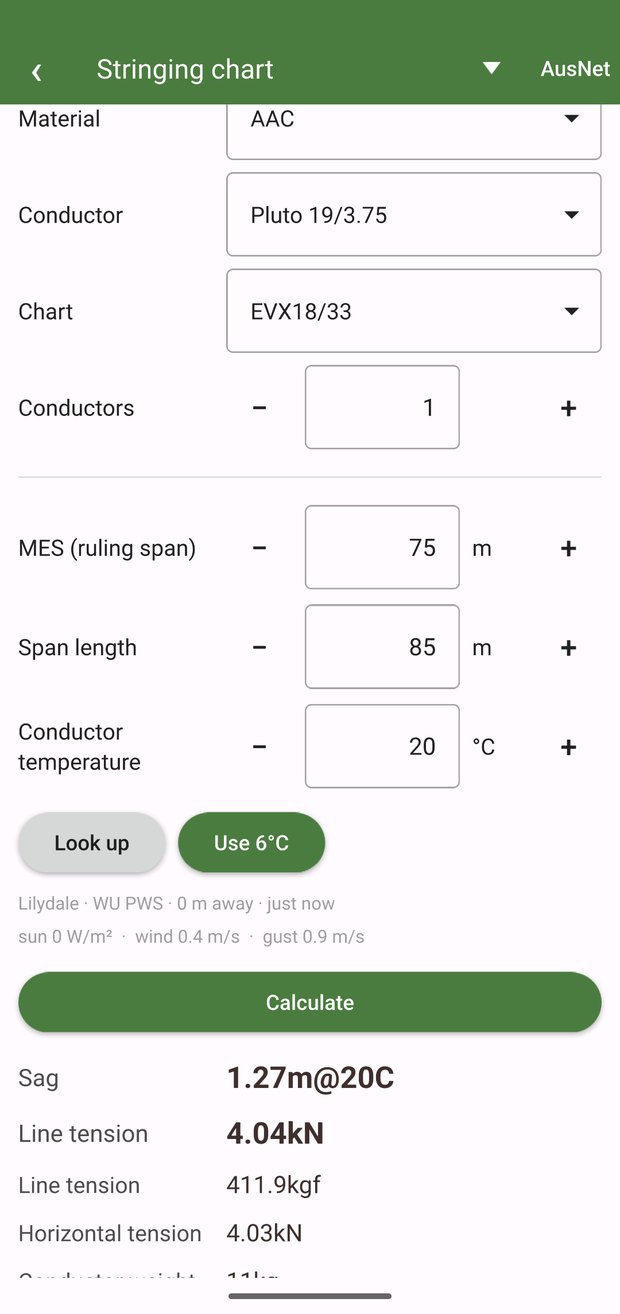
- Stringing chart: the sag and tension to string to, at a chosen MES, span and conductor temperature, with the timing a linesman counts and the sag anywhere along the span.
- Individual span: one span on its own, for supports at uneven heights, started from the chart, from a sag measured in the field or from a tension.
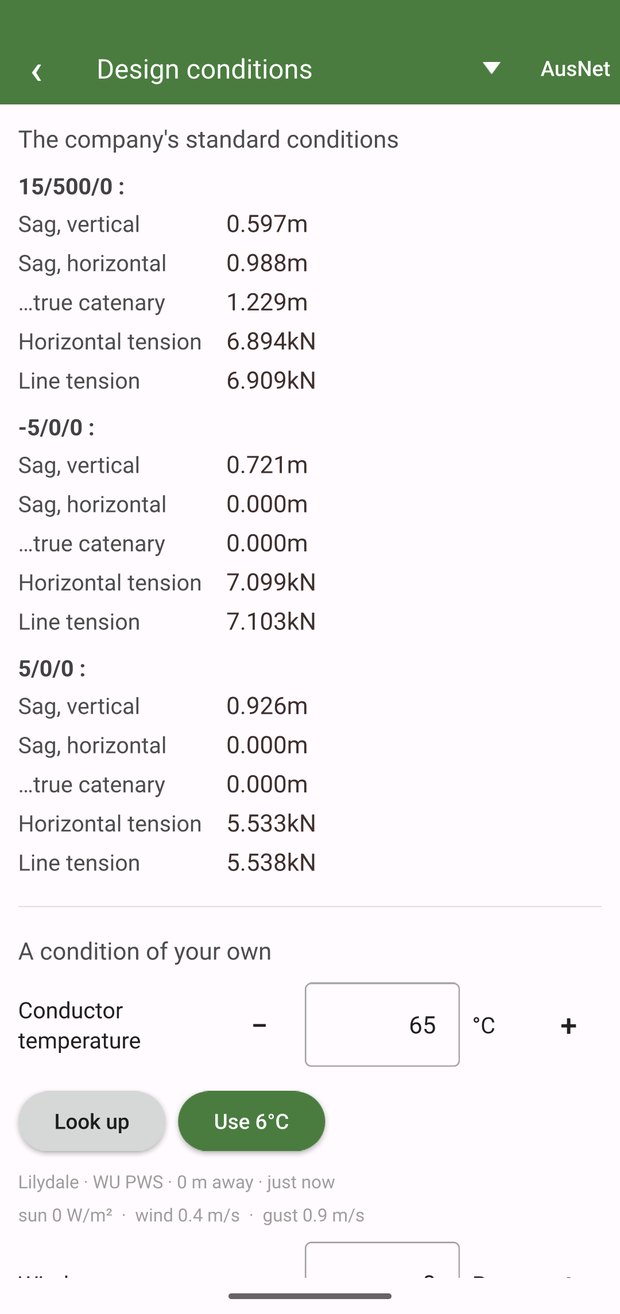
- Design conditions: the company’s three standard conditions worked out together, and a fourth of your own, with the sag at any chainage along the span.
- Lifting load: what the pole carries while a line is worked on, from the spans either side.
- Heart-wood rot: what is left of a wood pole’s strength, from the sound wood you can measure.
The company’s own numbers
The same distributor profiles the desktop carries: every stringing chart and conductor loaded from the company you pick, so the answer is the one that company designs to. Change company in the header and every calculator follows.
The design conditions come from the company too — in Victoria 15°C at 500 Pa, and −5°C and +5°C for the long-duration cases — worked out together, with a fourth of your own underneath.
The conditions of the day, not of last week
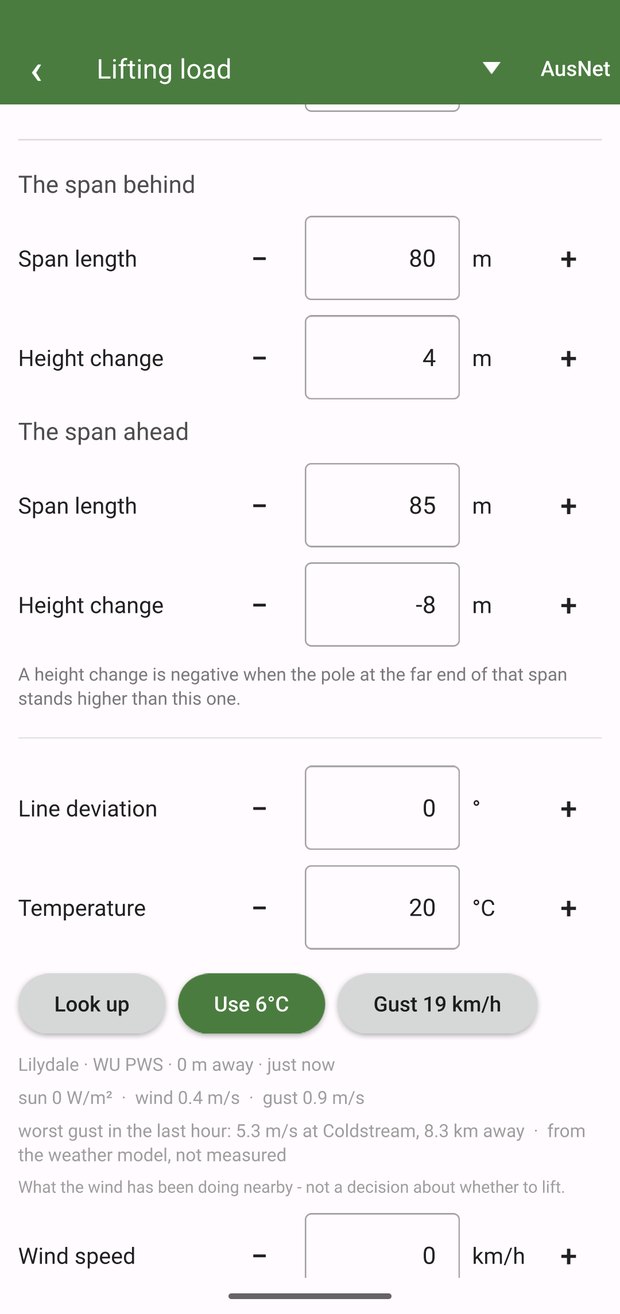
Tiny asks nPoles’ own weather service what the air is doing where you are standing, and offers it for the conductor temperature.
A lift is worked out against gusts, so it offers the worst gust of the last hour rather than whatever the wind happened to be doing at the moment you looked — the strongest reading nearby, with the station that saw it named and its distance, and said plainly when it came from the weather model rather than an anemometer.
A sheltered station reads almost no wind while an open site a few kilometres off reads the real thing, and a lifting load goes with the square of the difference. It is what the wind has been doing; the decision to lift stays yours, and the screen says so.
Victoria’s horizontal swing
Where a distributor swings the still-air sag through the wind angle instead of blowing the catenary out — the method AusNet and Powercor require — Tiny gives that figure and the true catenary swing beside it, so the number you design to and the number the conductor will really make are both in front of you.
On the phone, and its own licence
- Android 9 or later. Free for 90 days from first use, then a Tiny licence — its own, not a seat of nPoles.
- Works without a signal once it has opened: the charts and conductors ride inside the app. The weather is the only part that needs the network.
- Updates itself from within the app, so a phone in the field is never waiting on a cable.